WSW, NY, November 23rd, 2026, FinanceWire
An approved burn drug is gaining hospital users. A Phase 3 program targets a much broader wound-care opportunity. Together, they make this small biotech’s next chapter worth following.
There is a Nasdaq-listed biotech that developed a drug capable of removing dead tissue from severe burns using enzymes. That drug is already FDA-approved, generating sales and gaining repeat orders from U.S. burn centers. Now the company is testing whether its enzymatic approach can reach a much broader market: chronic wounds that refuse to heal.
That company is MediWound (NASDAQ: MDWD), and its next chapter could change the scale of the business.
At the November 20 close, MediWound had an equity market value of roughly $196 million. Behind that figure are two connected opportunities: the commercial expansion of NexoBrid, its approved burn treatment, and the development of EscharEx, its investigational chronic-wound drug. Understanding both is the starting point for understanding what this company could become.
The First Drug Already Has Returning Customers
NexoBrid addresses a difficult step in burn care. Dead tissue has to be removed so clinicians can assess and manage the injured area. For deep partial-thickness and full-thickness thermal burns, NexoBrid provides an enzyme-based method of removing that tissue, offering an alternative to surgical removal.
Its North American commercial partner, Vericel (NASDAQ: VCEL), reported record quarterly NexoBrid commercial revenue of $2.3 million in the third quarter of 2026, up 54% from a year earlier and 46% from the preceding quarter. Another $3 million came to Vericel from federal procurement.
The customer behavior is just as interesting. More than 80 burn centers have ordered NexoBrid, and approximately 70 have placed repeat orders, according to MediWound’s November 12 update. More new ordering centers were added in the first nine months of 2026 than during all of 2025.
Returning orders suggest clinicians are finding a place for NexoBrid in routine practice. Emergency preparedness gives the product another role.
MediWound participates through product supply and royalties under its agreement with Vericel. Those economics give it an ongoing interest in the franchise’s growth as it advances its next product.
A Burn Drug Governments Want Ready Before a Crisis
A fire or battlefield can produce more burn patients than local surgical teams can handle. NexoBrid’s ability to remove dead tissue without surgical excision gives it a role when those resources come under pressure. Following the Crans-Montana New Year’s fire in Switzerland (December 31, 2025), MediWound reported that NexoBrid was used to treat burn patients at specialized hospitals in Lausanne and Geneva.
The U.S. has already turned that preparedness need into procurement. In April, BARDA, the federal agency responsible for developing medical countermeasures, awarded Vericel a ten-year NexoBrid contract worth up to $197 million, including options. Its approximately $35 million base period includes initial procurement for the Strategic National Stockpile and other activities. Procurement began in the third quarter.
Separately, U.S. military funding supports development of a room-temperature-stable formulation for battlefield burn care, with a total program budget of $21.8 million. That formulation remains in development.
Recent conflicts have made resilience a more explicit spending priority. The June 2025 NATO Hague Summit commitment includes civil preparedness within its broader defense and security investment commitment. For MediWound, the opportunity is to supply a treatment governments want available before an emergency. Existing U.S. procurement and funded development give investors a concrete reason to watch NexoBrid as preparedness budgets evolve.

Chronic Wounds Could Change the Commercial Scale
The connection between burns and chronic wounds is dead tissue. In wounds that remain open, removing that material helps prepare the wound for healing. MediWound is developing EscharEx to perform that task, starting with venous leg ulcers associated with impaired blood return from the legs.
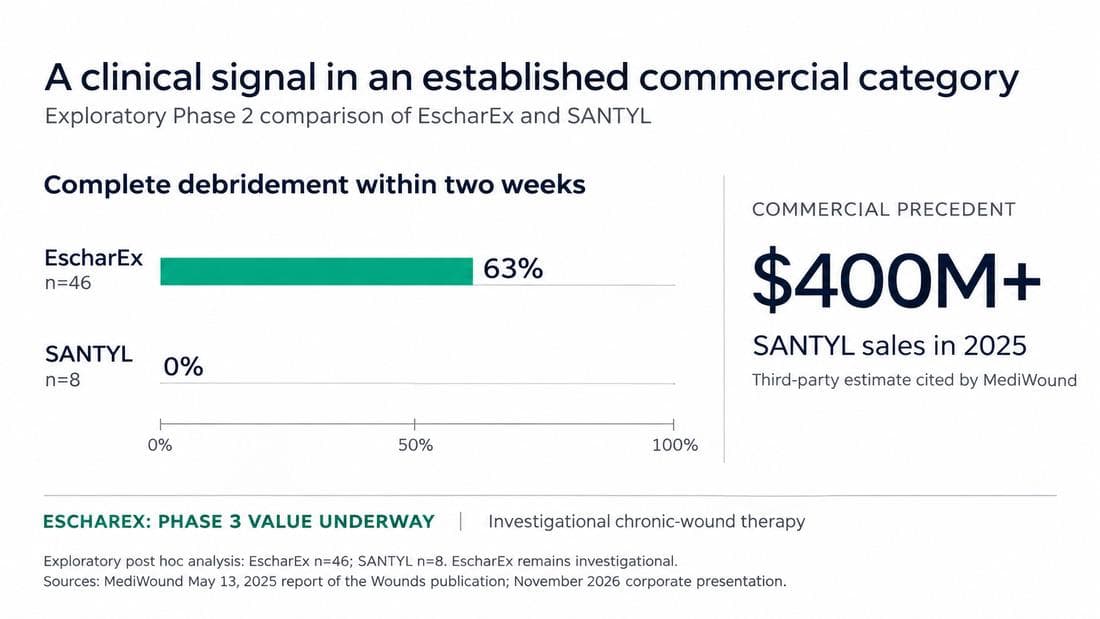
The commercial precedent is already substantial. Smith+Nephew’s SANTYL, a longstanding enzymatic wound ointment, generated more than $400 million in 2025 sales, according to third-party market data cited in MediWound’s November presentation. That is more than twice MediWound’s entire equity valuation. Smith+Nephew has confirmed that its talks with Johnson & Johnson regarding orthopaedics have ended and continues to prioritize advanced wound management.
EscharEx has produced encouraging evidence of a faster approach. In a published exploratory post hoc analysis of Phase 2 data, 63% of 46 EscharEx patients achieved complete removal of dead tissue within two weeks, versus none of eight SANTYL-treated patients. The comparison was small and post hoc, but it illustrates the potential clinical improvement MediWound is pursuing in a category already supporting hundreds of millions of dollars in annual sales.

The Phase 3 VALUE trial now targets 216 patients across approximately 40 sites. It evaluates both complete removal of dead tissue and facilitation of wound closure. Successful pivotal results could move EscharEx closer to a potential commercial future in chronic wound care.
Beyond venous leg ulcers, MediWound’s development ambition includes diabetic foot ulcers and pressure ulcers. The VALUE Phase III study for venous leg ulcers is ongoing, and preparations for diabetic foot ulcer and pressure ulcer trials are underway. An independent consulting assessment, reported by the company, estimates potential annual U.S. peak sales of $1.05 billion across those three indications, subject to further development, approvals and commercial execution.
Additional studies are needed beyond the initial indication. The ambition is to build a franchise across several major categories of chronic wounds.
The Next Checkpoint Is Coming Into View
MediWound expects enrollment completion and an interim sample-size reassessment by the end of the first quarter of 2027. That checkpoint evaluates the study’s size; final efficacy results follow separately.
The company closed a $17.25 million gross financing in November. While it remains loss-making, that additional capital supports the work needed to advance its clinical and commercial programs.
This is what makes MediWound’s current stage intriguing. A roughly $196 million equity valuation encompasses an approved product with growing hospital adoption and an investigational product pursuing a potentially much larger opportunity. The appeal is the combination: a product earning a place in clinical practice today, alongside a second program that could substantially broaden the business.
NexoBrid already connects MediWound to hospital demand and national preparedness. EscharEx could take it into a category where an established enzyme drug generated more than $400 million in 2025. The coming clinical milestones will help determine how much of that broader opportunity MediWound can pursue. At its current size, that is a consequential next chapter.
Recent News Highlights from MediWound (NASDAQ: MDWD)
MediWound Reports Third Quarter 2026 Financial Results and Provides Corporate Update
MediWound Announces Closing of $17.25 Million Bought Deal Offering of Ordinary Shares
MediWound Announces $15 Million Bought Deal Offering of Ordinary Shares
Independent DSMB Recommends MediWound’s EscharEx Phase III VALUE Study Continue Without Modification
MediWound to Present at the H.C. Wainwright 28th Annual Global Investment Conference
Important Disclaimers and Disclosures: The author, Wall Street Wire, is a content and media technology platform that connects the market with under-the-radar companies. The platform operates a network of industry-focused media channels spanning finance, biopharma, cyber, AI, and additional sectors, delivering insights on both broader market developments and emerging or overlooked companies. Wall Street Wire is not a broker-dealer or investment adviser. References to market size estimates, valuations, price targets, or other third-party data are provided strictly for informational purposes. Wall Street Wire receives cash compensation from MediWound Ltd. (the “Issuer”) for coverage and awareness services, which are provided on an ongoing subscription basis. The content above is a form of paid advertising and promotion and is for informational purposes only and does not constitute financial or investment advice. This article may contain forward-looking statements about the Issuer’s products, plans, or prospects that are subject to risks and uncertainties; actual results may differ materially, and readers should review the Issuer’s public filings on SEC EDGAR (sec.gov/edgar) for full risk factors. Market size figures, research estimates, or other third-party data referenced in this article are quoted from publicly available sources believed to be reliable; however, we do not independently verify or endorse them, and additional figures or estimates may exist. Full compensation details, information about the operator of Wall Street Wire, and the complete set of disclaimers and disclosures applicable to this content are available at: wallstwire.ai/disclosures. This article should not be considered an official communication of the Issuer.
ContactWall Street Wire
[email protected]