Rome, Italy, June 1st, 2026, CyberNewswire
As decentralized VPN adoption grows across privacy-conscious and censorship-affected user segments, RaccoonLine today published an introductory guide explaining the structural difference between centralized and decentralized VPN architecture, who benefits from each, and what the trust model difference means in practice.
VPN stands for Virtual Private Network. The basic concept is familiar: encrypt your internet traffic and route it through a server that sits between you and your destinations. Websites see the server's IP address rather than yours. A decentralized VPN does the same thing at the surface level. The difference is in the infrastructure that sits in between, and what that infrastructure means for privacy, availability, and resilience.
How a Regular VPN Works
A regular VPN routes your traffic through servers owned and operated by the VPN company. When you connect, your traffic goes to a company server in whatever country you select. That server makes the connection to your destination on your behalf and passes the response back. The VPN company owns the servers, controls the software running on those servers, and operates as a centralized intermediary between you and the internet.
This works well for the most common use cases: hiding your IP from websites, bypassing geo-restrictions on streaming services, encrypting traffic on public Wi-Fi. The centralized model is fast, simple to use, and well-supported across devices. The limitation is the company itself. A centralized VPN provider is a legal entity that can receive government orders, be hacked, or choose to share data with third parties. Users trust the company's promises about how their data is handled.
How a Decentralized VPN Works
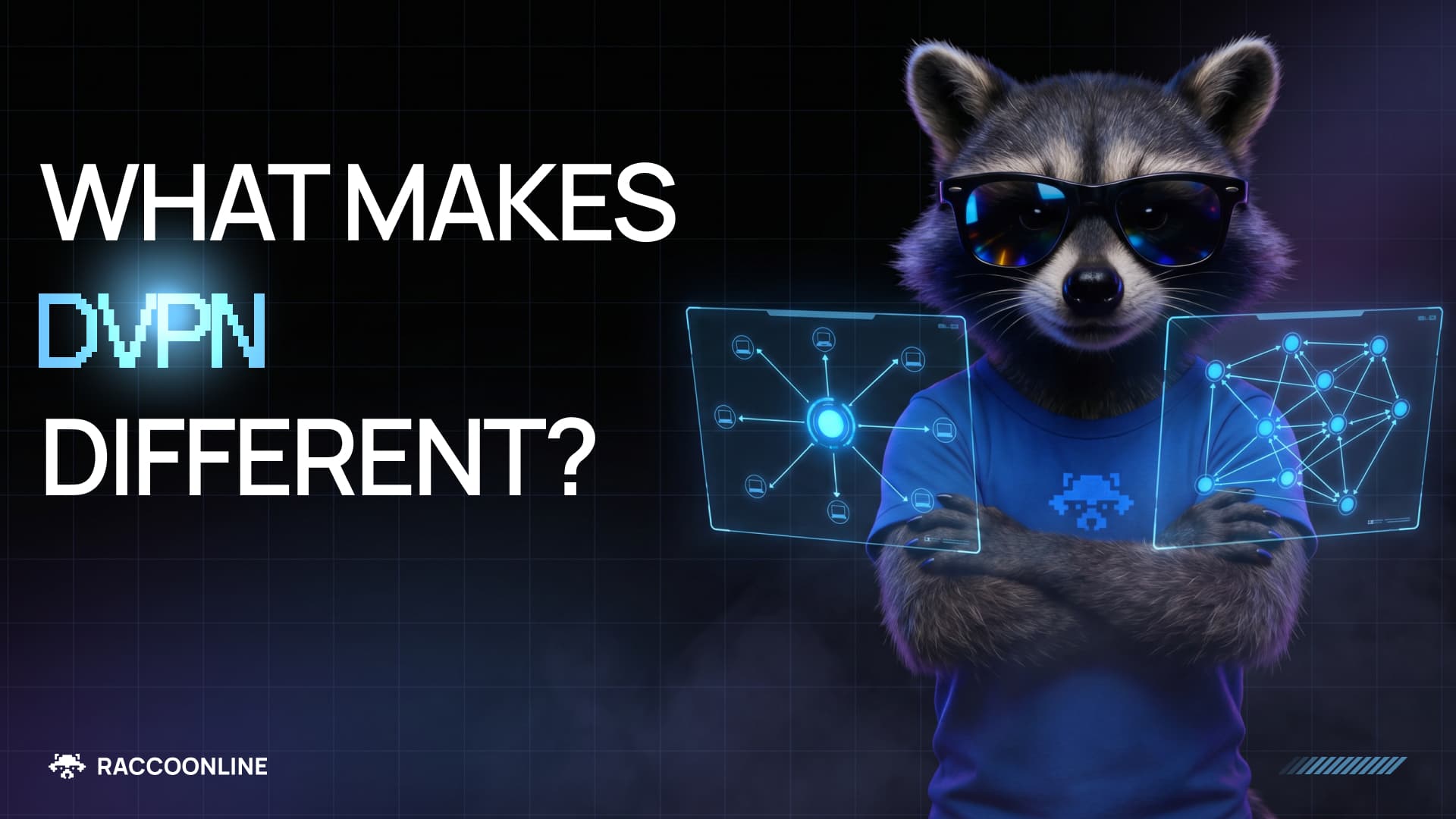
A decentralized VPN routes traffic through a network of independent nodes rather than servers owned by a single company. The nodes are run by individual operators, each contributing their internet connection to the network. Traffic is fragmented across multiple nodes in sequence. The entry node knows who is connecting but not the final destination. The exit node knows the destination but not who originated the connection. No single node holds the complete picture.
There is no central company server holding connection logs. There is no single entity that can be served with a legal order to produce records, because no single entity holds them. The privacy guarantee comes from the architecture rather than from a company's policy.
The Key Differences in Practice
Trust model: a regular VPN requires trusting the company. A dVPN requires trusting the protocol design and the distributed architecture. These are different kinds of trust with different failure modes.
Legal exposure: a regular VPN provider can be compelled to produce connection records if it holds them. A dVPN with P2P routing has no central records to compel. Each node operator holds only a fragment that is useless without the others.
Censorship resistance: most regular VPN protocols are identifiable by deep packet inspection. Some dVPNs use protocols designed specifically for invisibility to DPI, such as VLESS, which produces traffic indistinguishable from standard HTTPS.
Speed: regular VPNs running WireGuard are typically faster than dVPNs using obfuscation protocols. In unrestricted environments, commercial VPNs have a speed advantage.
Who Benefits From a dVPN
Users who need geo-restriction bypass or basic privacy from ISP tracking are well-served by a commercial VPN. The trust model is adequate, the speed is better, and the server selection is wider. Users whose threat model includes government surveillance, legal pressure on service providers, or operation in countries with active DPI censorship get meaningfully different protection from a dVPN. The structural privacy guarantee and the protocol-level censorship resistance address risks that a centralized VPN with a no-log policy cannot.
About RaccoonLine
RaccoonLine is the decentralized VPN referenced throughout this guide. It uses VLESS protocol with Wandering Flow routing, runs on residential P2P node IPs, and includes built-in decentralized file storage alongside traffic routing. The product is designed for users whose use case requires structural rather than policy-based privacy guarantees. More information is available at raccoonline.com.
ContactCMO
German Melnik
RaccoonLine
[email protected]